The MBA programme provided at the Eastern and Central Europe campus is designed for senior and middle managers of international and Ukrainian companies from various business domains: agriculture, heavy and light industry, pharmaceuticals, FMCG, banking, public administration, IT, etc.
We stay in touch with the majority of our alumni through an active Alumni Club, and have the ability to observe how the knowledge gained enables leaders to revitalise their businesses and companies and reassess their own successes from a new lens.


It turned out to be the fastest 3 years of my life. Over this period, I discovered that there were days with more than 24 hours in them when I needed them. Those were 3 years where I learned a lot of valuable and insightful information. Those were 3 years which radically changed my life.
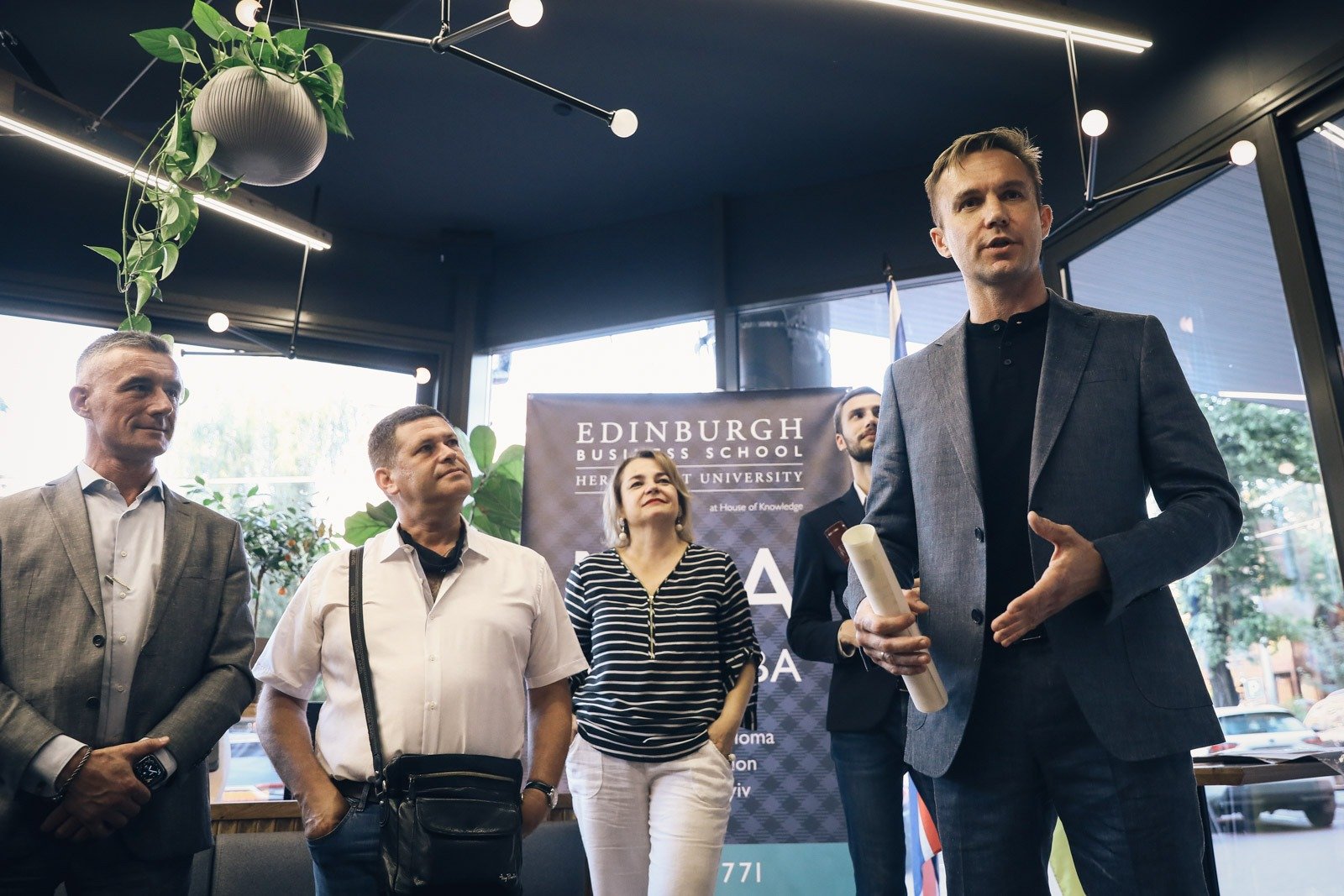
At the 2020 initiation ceremony, Mr. Kurinnyi greeted the fresh students on their commitment to the MBA programme: «This decision can change not only your career, but also your life, certainly for the better.
At the time of my enrolment in 2017, I felt a great challenge and indeed some concerns about the fact that I would have to study and pass exams in 9 courses. The positive news is that you manage them all, the negative news is that you have to learn everything. This is the peculiarity of the programme: when you graduate, you know a lot.
You can zigzag to your mission and vision for a really long time. And possessing the tools that an MBA can give you, you will make this journey faster and get there quicker… After that you will become a sort of a missionary for business education. You will reconsider not only your attitude to business, but also to one another»
Globalisation and constant change have created the conditions under which professionals from all sectors of the economy must increase their personal productivity and competitiveness.
Edinburgh Business School’s MBA programme contributes to the formation of a modern ‘smart bank’: all the knowledge and skills you acquire allow you to implement consulting projects of high complexity at the national and international levels. A British-quality business school helps top managers to take a fresh look at all areas of the company’s operations – economics and finance, human resource management, marketing and strategic planning.
Reasonable tuition fees with no additional logistics costs, a well-designed curriculum with internationally recognised methodology, a well-thought-out practical component and strict knowledge control, and a guarantee of a British diploma, which allows EBS graduates to be competitively sought after as specialists on a par with graduates of business schools in the US or EU.
Successful practical work as an economic expert in assessing damages in international arbitration courts and other corporate disputes is a vivid example of the high quality and exceptional value of the Edinburgh Business School MBA programme.
You can find many pros and cons of an MBA degree on the Internet. For instance, the pros highlight a wide network of useful contacts, a comprehensive approach to business and to particular areas of management, and career advancement. Opponents point to the high cost of education, the long duration of study, and the impracticality of theoretical concepts in the immediate future.
It is hard to argue with some of the arguments for and against, while others are losing their relevance in our rapidly evolving world. When working for my company in Ukraine (professional services), I found my MBA programme helpful in the following circumstances:
Getting new clients and winning contracts by winning tenders. In our country, after the emergence of platforms that allow for electronic procurement, the number of tenders has increased in both public and private enterprises, and their quality and transparency have improved. The availability of diverse and high-quality diplomas that indicate a high level of knowledge in various fields is a frequent requirement when choosing consulting services. That is why my diploma has been monetised several times in the most direct way.
Improving the employer image of our company by obtaining the status of an Accredited Employer. To obtain this status, you need a certain set of knowledge and skills. An MBA diploma helps with this.
And crucially, the MBA programme assisted me in developing a mindset aimed at continuous professional education and helping me to structure approaches to obtaining new skills for both myself and my colleagues.
I was confident that I would graduate from the MBA programme in less than 3 years. I had even written about that in my application essay. Thanks to the knowledge and professional advancement, thanks to the ease with which I could immediately employ the methods in practice, a significant part of my professional life has changed. And now, just like when I enrolled, I am convinced that I will be capable of transmitting the acquired knowledge to my children.
I am very grateful to the student support team for promptly handling any issues. I am very grateful to the tutors for their competence and inspiration to keep learning.
A colleague of mine, who is also a graduate of Edinburgh Business School, and I together have the privilege of discussing the company’s business processes, benchmarking them against global trends and modern approaches, and implementing our ideas. And I would like to underline that all of this is really effective in everyday practice.
Networking, knowledge and skills are converted into business achievements.
Although in 2017 I only came to attend one course, rather than the entire programme, today I am an MBA graduate.
Immediately after the first year, I was impressed by the effect of the programme on the ability to think critically and make decisions on a different scale. I made more and more discoveries with each course.
We lawyers, when we address colleagues at conferences or when we mentor young partners and junior associates, always repeat: ‘Know your client’s business model. And by that we mean: understand metallurgy if you work with a metallurgist; understand pharmaceuticals if you work with a pharmacist, and so on.
But in the process, it becomes clear that one needs to know the economics of an enterprise in order to communicate with the people who manage it. You need to know finance to understand how the CFO reasoned when he or she said that this particular investment would not be very profitable. The MBA programme provides you with this understanding.
As a result of my studies at Edinburgh Business School, I was able to take a 360-degree view of business, focusing on how finance, accounting, marketing and human resources work hand in hand in a strategic and holistic way.
Since I was a child, I have memorised the saying ‘Luck favours the prepared’ and I have been carrying it with me since then. I believe that every person is given chances throughout their lives. The trick is to grasp and utilise these chances. The MBA as a tool helps to see opportunities, understand them, and take full use of them. My gratitude to all the tutors who gave me ‘’clocks‘’, days of fascinating lectures and captivating stories. My gratitude goes to all the students who were by my side.
An MBA is neither a panacea nor a golden fish. Any achievements after obtaining a Master of Business Administration degree will be a function of two variables, namely, the knowledge and skills you acquire. Obtaining an MBA is more of a paradigm shift, where your general outlook on life and job is altered, as well as the number of efforts and goals you set for yourself. At a certain point, there comes a time in life when you feel the urge to generalise, to build a solid foundation for your experience and skills. If you are at this stage of life, everything will work out for you.
Thanks to the knowledge I gained at Edinburgh Business School, I was able to build up effective internal administration and establish productive relationships with all stakeholders.
As the school’s executive director, I required knowledge not only of finance, but also of organisational structure, understanding of human resources, large-scale project management, marketing and strategy. At that time, some of my friends were already studying at the Edinburgh Business School MBA programme and they recommended it to me. After attending a MBA presentation, I was convinced that it was exactly what I was after! And now I personally recommend this programme to my colleagues and friends, referring to the systematic approach to learning, a large number of practical cases and teamwork.
Just during my studies at the programme, I have managed three construction projects. So the knowledge obtained during the Project Management, Organisational Behaviour, Negotiation and Leadership courses was particularly relevant to me. Thanks to this knowledge, I succeeded in building perfect internal management and establishing productive cooperation with all stakeholders.
The curriculum is based on the British model and is developed by professors from Western business schools. In other words, this is the case where you study in Ukraine, but in the end you graduate from a British business school.
Edinburgh Business School’s tutors at the House of Knowledge campus make the most complex things look simple: no longer do you feel overwhelmed by a complicated topic, but rather want to understand more and in more depth. Thanks to the MBA programme, I managed to look at the functioning of an entire organisation from high above.




EBS students and alumni are employed
in a range of different fields and roles
in their own businesses, start-ups and market-leading companies:


